Before seeking counseling, people often turn to tools such as Google and LLMs such as ChatGPT to learn more about their symptoms and decide whether to seek help.
Here at Counseling.co, we decided to use this data to uncover which mental health issues are most prevalent right now, and how these disorders have trended over time.
Mental health search study
To analyze trends in mental health disorder searches over time, we gathered Google search data for the United States, dating back to 2015.
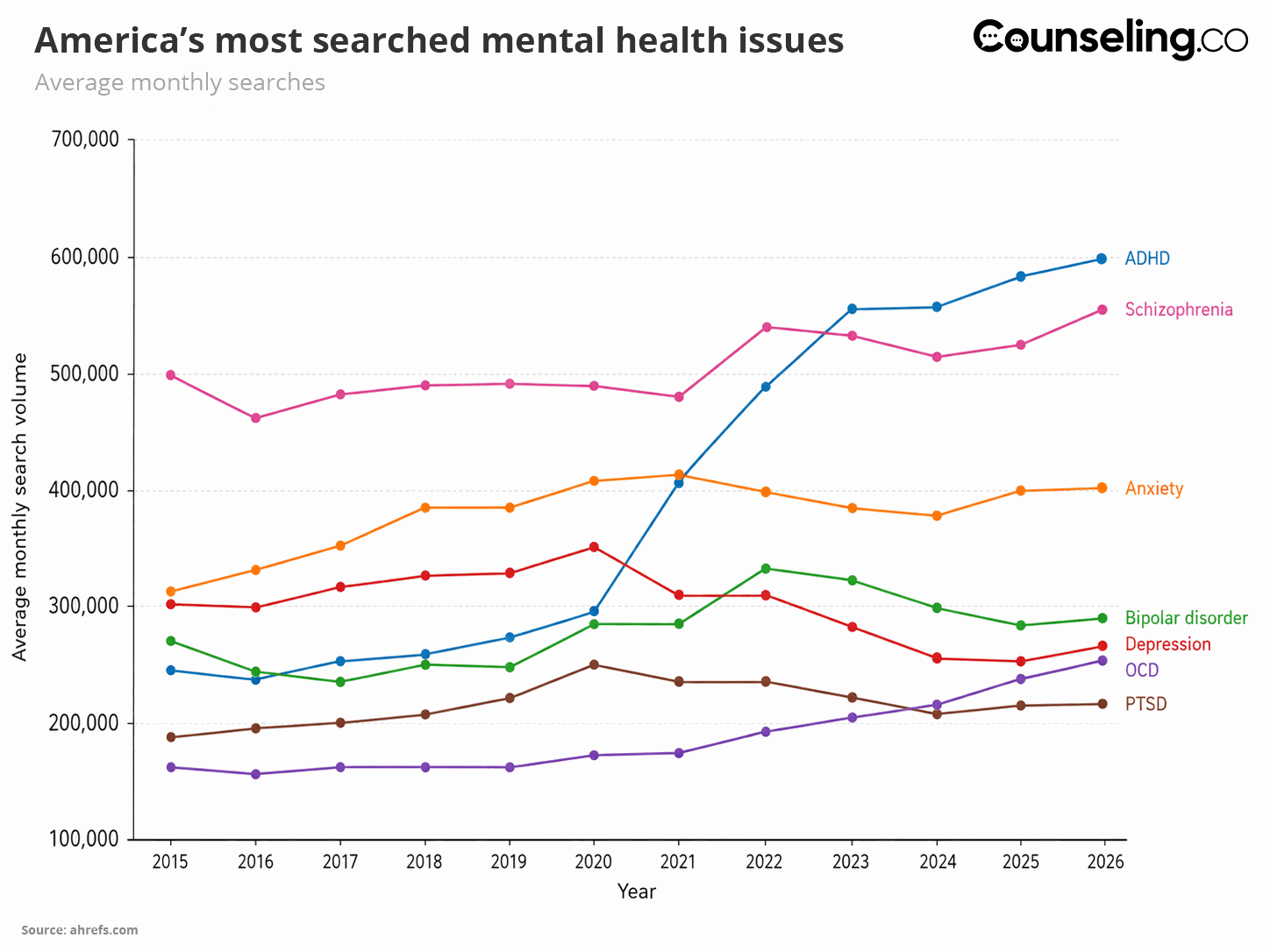
Raw data (average monthly Google searches)
| Year | ADHD | Schizophrenia | Anxiety | Bipolar disorder | Depression | OCD | PTSD |
|---|---|---|---|---|---|---|---|
| 2015 | 243,225 | 499,944 | 312,318 | 270,694 | 301,818 | 163,810 | 190,749 |
| 2016 | 237,270 | 463,653 | 330,736 | 244,467 | 298,594 | 159,227 | 197,460 |
| 2017 | 251,484 | 482,871 | 351,251 | 237,716 | 313,674 | 163,603 | 201,934 |
| 2018 | 257,326 | 489,820 | 384,025 | 253,622 | 323,531 | 163,879 | 209,025 |
| 2019 | 271,193 | 491,201 | 383,904 | 250,749 | 325,116 | 163,865 | 223,243 |
| 2020 | 292,067 | 489,199 | 407,889 | 286,981 | 346,035 | 175,240 | 249,272 |
| 2021 | 402,936 | 481,067 | 413,585 | 285,660 | 306,431 | 177,524 | 235,921 |
| 2022 | 487,496 | 539,902 | 397,469 | 326,943 | 306,876 | 195,020 | 236,250 |
| 2023 | 556,281 | 532,085 | 383,363 | 316,891 | 280,534 | 207,403 | 222,039 |
| 2024 | 558,176 | 515,052 | 377,656 | 296,356 | 255,494 | 219,889 | 209,740 |
| 2025 | 584,170 | 525,287 | 400,414 | 283,100 | 252,720 | 241,542 | 216,510 |
| 2026 | 597,763 | 555,792 | 401,655 | 288,567 | 264,927 | 260,087 | 218,468 |
From anxiety to ADHD
Google searches for anxiety peaked during COVID in 2020 and 2021, but steadily declined as society stabilized. Meanwhile, ADHD-related searches have continued an aggressive, linear climb, doubling in volume over the last six years.
During the COVID-19 pandemic, people sought answers for acute, threat-based anxiety. However, as lockdown restrictions increased the amount of time we spend looking at screens, society has become even more hyper-digitalized, and our collective symptoms have changed. Our focus has moved from “Why am I anxious?” to “Why can’t I focus or sustain attention?”
Why ADHD searches have doubled since 2020
Beginning in 2020, TikTok exploded in popularity, and Instagram Reels were launched in August of that year.
Though short-form video apps and predictive recommendation algorithms existed before 2020, this was the first time that society at large was exposed to this type of technology. As of 2023, TikTok reported having 130 million active US users.
These apps on their own do not cause ADHD, as it is a neurodevelopmental disorder, usually identified in childhood, rather than a behavioral condition.
However, these technologies can reduce our ability to focus for extended periods on tasks that require our full attention, leading to a significant increase in levels of distress presented through symptoms perceived as linked to ADHD.
While the prevalence of ADHD in the United States has not increased to the extent that the data implies, our society’s evolving relationship with technology since 2020 has led to a significant uptick in ADHD-adjacent symptoms that people are presenting with.
Overcoming these symptoms
Since these symptoms are environmental rather than biological, the focus is on behavioral recalibration rather than prescribing medication to treat patients.
Therapists are primarily using Cognitive Behavioral Therapy (CBT) to help people regain control, through methods such as:
- Behavioral activation, which involves recalibrating the brain’s reward system by scheduling low-dopamine tasks. In practice, this looks like “monotasking”: for example, reading a physical book for 20 minutes without a phone nearby, or performing activities such as gardening or crafts to build back a tolerance for slower-paced, lower-dopamine tasks.
- Metacognitive training, where patients are taught to catch their own attention slips in real-time. A common method is “Stop-and-Check,” where random timers prompt the patient to ask, “Am I on task or am I looping?” Therapists also help patients use “distraction logs” to track the emotional triggers that lead to compulsive scrolling.
- Cognitive restructuring, which helps patients identify and challenge the compulsive urge for the next digital hit, then change their behavior to do something else instead.
As an individual, it is also recommended to practice digital hygiene: keeping low and high-dopamine activities separated – for example, defining blocks of focused work time where you cannot use your phone, or not looking at screens in the hour before going to sleep.
Methodology
We used Ahrefs to access Google search volume data for each mental health issue we assessed.
For each topic, we gathered data on the number of Google searches each month of the year since 2015. We then calculated the average monthly search volume for each disorder in each of the last 11 years.
We started with a large list of mental health topics, and in our final report, only included those with at least 100,000 average monthly searches in each year over the last decade, in order to focus on only the most searched mental health topics. As a result, some other less frequently searched disorders are excluded from this analysis.