If you’re looking to get more clients for your therapy practice, it can be quite difficult to know where to start.
A lot of the advice out there about therapist marketing is often vague, or not always explained in a way that’s easy to understand if you’ve never really done this sort of thing before.
So today, I thought I’d put together a fairly simple guide explaining some of the marketing strategies we’ve seen work best for private practice therapists and counselors.
For each strategy, I’ve explained how it works, why/when it works, and what you need to know to implement it, if you think it could be helpful for your business.
If you’re searching for more in-depth information about growing your therapy practice, we recommend checking out our guide to getting more clients for your counseling business.
And if you’re looking for more personalized help, you might like to book a consulting call with me to ask absolutely any questions you might have about marketing and growing your therapy service.
You can also subscribe to our mailing list using the form below to get the occasional bit of therapy marketing advice in your inbox, if you’d like.
Contents
- Strategy #1: deliver value to your niche
- Strategy #2: network with local therapists, clinicians, and other professionals
- Strategy #3: digital marketing
- Strategy #4: data-driven marketing
- Strategy #5: deliver an even better service
- Conclusion
Strategy #1: deliver value to your niche
I realize this might sound a bit vague, so let me explain.
As we discuss at the beginning of our more in-depth guide to getting more clients as a therapist, the number one most important thing you can do to grow your therapy business is niche down as much as possible.
Serving a specific group of people, or solving a specific problem, positions you as the best source of help for a certain community, rather than just being another therapist amongst hundreds of others.
Niching down makes it much easier to stand out, and is the number one piece of therapist marketing advice we usually provide.
Once you’ve defined your niche, you want to deliver value to this audience, to build trust in your expertise, and spread the word about the support you offer.
Depending on the niche you’re focusing on, this could involve:
- Offering to present on common mental health issues affecting your audience, and how they can be addressed.
- Running workshops or another more interactive type of session to teach people skills and coping strategies.
- Building a blog around common mental health issues in your niche.
For example, if you specialize in helping with work-related burnout and stress, businesses in your town/city might be interested in having you along for a lunch and learn session.
And if you provide Christian counseling, you might like to blog about topics such as crises of faith, pastoral burnout, and so on, or speak on these issues at local churches.
Providing this sort of help does take time, but in the long run, the benefits of this marketing strategy are immense. It can have a huge snowball effect once people pick up on what you offer, and begin to build trust in you as a therapist.
As you begin delivering value (meaning, running workshops, doing presentations, or blogging), make sure to gently explain how you help people in the community, and what the next steps are for someone looking for support.
You obviously don’t want to be pushy, but make sure to have a clear call to action for people that do want more help, whether it be immediately or in the future.
This could look like a flyer you hand out explaining what your therapy services involve, or a brief introduction of who you are and what you do at the end of your blog posts.
I realize that you might be looking for more detail on implementing these types of strategies, especially blogging.
If you need help in this area, or just want your marketing plan sanity checked, book a consulting call with me to make sure you’re on the right track before you get started.
Strategy #2: network with local therapists, clinicians, and other professionals
Another incredibly powerful marketing strategy for therapists is building your referral network.
You may not think of this as marketing, but in truth, marketing is not just advertising – it’s relationship building as well, whether it be with clients, community groups, or other medical professionals.
Even if you do have a pretty strong network to begin with (which is a fantastic start), it’s worth thinking about whether there’s any more you can do to make it even stronger. You can often improve the value of your network by thinking a bit outside the box.
Say you’re an LMFT, and you’re a native Spanish speaker who specializes in helping latinx couples.
With family lawyers and mediators in your area, especially those that serve the latinx community, you want to create an automatic response: if they are approached by a latinx couple who could benefit from counseling, you should be their first port of call.
Again, the key to being able to do this successfully is to define your niche, and communicate it clearly.
If you approach other professionals such as family lawyers with a broad service offering, such as “I provide couples counseling” or “I help people manage anxiety, depression, and stress,” it is much less memorable, and you’re not really giving them a specific reason to refer people to you.
Instead, you need to be very specific in stating who and how you help – it should be a small, well-defined group of people. This way, you’re much more likely to be remembered when someone is looking for the support you provide.
There are a huge range of other professionals it can be worth networking with, depending on your niche – some obvious, and some less so:
- GPs/primary care clinics
- Psychiatrists
- Other therapists serving different niches
- Physiotherapists, pain clinics, sleep clinics
- OB-GYN/fertility clinics (perinatal, postpartum)
- Dietitians (ED work)
- Substance misuse services
- Coaches – sports, executives, career counselors
- Yoga/pilates studios (anxiety, stress)
- Community organizations (domestic violence, LGBTQ+ centers, bereavement charities)
Cold-approaching people (and being very friendly) is often a good approach, but it can seem difficult, especially if you don’t have an extroverted personality.
If you don’t want to do that sort of thing, remember that networking can be as simple as sending letters introducing yourself, which can be surprisingly effective if written well.
If possible, you can also start by sending referrals the other way to begin with, potentially also accompanied with an email or a letter.
Strategy #3: digital marketing
From having owned a number of therapist directories over the years, and having worked with private practices of all sizes, we have seen first-hand the huge numbers of people that turn to the internet in search of a therapist.
For mental health professionals, this means focusing on three main things:
- Search engine optimization (SEO). This involves work you can do to improve your visibility in Google, Bing, and other search engines. This also covers optimizing for AI search on LLMs such as ChatGPT – thankfully, most SEO work you do will help with AI visibility as well. People are increasingly using LLMs for their perceived ability to provide personalized answers on sensitive subjects, and this includes searching for therapists.
- Website optimization. Ensuring that when people land on your website, they are likely to contact you to book a session.
- Directory optimization. Ensuring you’re listed on the therapist directory or directories your audience uses, and that you’re describing yourself optimally.
These topics could each easily be an article on their own, which we will likely write at some point. We have discussed the first two especially in more detail in our guide to getting more clients as a therapist.
Broadly speaking, to improve your digital performance:
- Ensure that the language on your website and directory listings engages your specific audience. It should clearly explain who you help and how, and the types of problems you help solve. You should use your audience’s language, and your writing should be free of jargon and easy to understand.
- You should have professionally-taken photos of yourself and ideally your therapy practice prominently displayed on your website, and these should also be posted to your Google My Business (GMB) listing. Ensure to set up and fully fill out your GMB listing if you haven’t already, to ensure maximum visibility on Google Maps, if you provide in-person counseling.
- Your business name should ideally speak to what you do, such as “LGBT Affirming Therapy Co” or “Anxiety & OCD Center Houston”. Then, ensure that this is represented accurately across your GMB business name, homepage title (editable for example in Squarespace under SEO/metadata settings), and homepage main heading (editable for example in Squarespace when you edit your homepage – look for the header labeled “Heading 1”).
- Your information across the web, including your business name, qualifications, and who you help, should be consistent.
- You should list your practice anywhere you are eligible to do so for free, such as the APA Psychologist Locator if you are a psychologist, to improve your web authority. Search engines and AI look at how others talk about you online (and how often you are mentioned) to measure your credibility.
- You should try to get as many Google reviews for your practice as possible, as these help improve your Google Maps visibility, and are also used by AI to assess your credibility.
Strategy #4: data-driven marketing
If you’re hopeless with numbers like me, don’t worry, this doesn’t involve doing any maths or working with huge datasets.
Apart from the number of clients it can drive, the other benefit of digital marketing compared to more traditional channels is how much easier it makes everything easier to track. You can figure out exactly where clients are coming from, and double down on what’s working, or fix issues that are holding you back.
So, once you have your digital presence optimized, as we discussed above, make sure you have a sense of how to measure the performance of different parts of your marketing plan.
This does not mean using data visualization software, or spending hours crunching numbers in Excel. It just means keeping track of where clients and website visits are coming from.
For example:
- Make sure to ask new clients how they found out about you. To get more data, you might also like to add this as a field on your contact form on your website. This is an old-school technique, but it’s really effective in helping you figure out what’s driving the most value for your business. And make sure to note down this information somewhere, like in a spreadsheet, so you can monitor performance over time.
- Use the “Performance” data available in Google My Business to find out what search terms clients are using to find your business, and whether they are finding you in Google search, or on Google Maps.
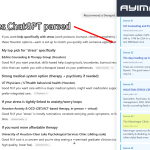
- Every so often, ask ChatGPT, or your preferred LLM (if you use one), for a therapist recommendation in your niche. It won’t be the case that you will always appear, or even often appear – LLMs take into account millions of different factors when choosing what products/services to recommend, and many of these determining factors are unique to each individual user. However, it’s worth looking at what other counseling services are consistently displaying, and why. For example, do they have lots of Google reviews? Do they have more mentions elsewhere on the web, such as therapist directories, the Better Business Bureau, and the local chamber of commerce? Does their website do a better job of speaking to the people in your niche?
- Consider using Google Search Console to get an even closer idea of what people are searching on Google to find your counseling service. This takes a few steps, but is easier if you’re using a website builder like Squarespace. For example, if people are mostly finding you by searching your name, this is great in that it means you’re getting word of mouth referrals, but it could mean you are not finding new clients searching more broadly for the type of therapy you provide.
- Consider using Microsoft Clarity to find out exactly how users are interacting with your website, such as which pages/paragraphs they are most interested in, and if they are ever getting confused or running into technical difficulties. This also takes a few steps to set up, but the insights this tool provides are invaluable.
- If you’re really advanced, you might like to use Google Analytics to look at which websites, search engines, and LLMs are referring traffic to you, but it does require installation, and is not essential to use. There’s a bit of a learning curve, like with the above two tools we mentioned.
Strategy #5: deliver an even better service
This may sound like it’s not marketing advice, but remember, marketing isn’t just advertising. The “product” – your counseling service – is one of the core elements of your marketing plan.
Once the other aspects of your marketing strategy are in place, the quality of the service you provide is the last step in the flywheel, ensuring customers keep visiting until they’ve worked through the issues they wanted to address, and helping you pick up word of mouth referrals – which are the cheapest way to acquire new clients, from a marketing investment point of view.
Unfortunately I’m not the most qualified to advise on how to deliver better counseling, as I’m not qualified as a therapist. There are many other articles out there that can help you improve your overall service, and you can lean on industry peers and professors for help potentially as well.
From purely a marketing point of view, anything you can do to align your therapy as much as possible with how you describe your service will be helpful. Meaning, do the best job you can helping the specific types of people you help with the specific problems you help with.
Conclusion
I hope this was useful!
I completely get that marketing can seem daunting as a therapist, so I’ve tried to provide clear recommendations instead of broad explanations.
I’ve also tried a bit to explain why certain things are worth doing, because this can make things easier to understand, and help justify the investment of your valuable time and money into implementing a given marketing strategy.
If you want a quick look at your marketing plan for your therapy business, or just want to ask me anything about growing your practice, book a call with me at a time that suits you.
And if you have any questions, shoot me an email at tom (at) counseling (dot) co.