If you’re an experienced therapist, you’ve probably heard quite a lot about Search Engine Optimization (SEO) over the years.
SEO is essentially the process of improving your visibility on search engines such as Google, doing things such as using keywords (specific words or phrases) in the right places for example.
But now, increasing numbers of people are using AI tools such as ChatGPT to search for counselors. As a private practice therapist, you may have already met clients who found your business using a Large Language Model (LLM).
So now, a new term has been coined in the marketing world – AI Optimization (AIO).
AIO involves improving your website and broader web presence to get more visibility on ChatGPT, Gemini, Claude, Perplexity, and other LLMs.
Today, we’ve explained what you need to know about AIO as a therapist, to get more clients from these AI tools.
But don’t worry – many parts of AIO are very similar to SEO, so optimizing for AI search does not involve a huge amount of extra work, especially if you have a bit of an understanding of SEO basics.
Before we begin, you might like to:
- Read our larger guide to getting more clients as a therapist, if you want to learn more about private practice marketing.
- Book a consulting call with me, if you want to sanity-check your therapy marketing plan, or ask any questions about marketing your counseling service.
Contents
- Introduction
- Step #1: Optimize your website
- Step #2: Get mentioned in more places
- Step #3: Get more reviews/testimonials
- Step #4: Ensure consistency in your web presence
- Step #5: Create content answering specific questions in your niche
- Conclusion
Introduction
Before we begin, I thought I’d give a bit of context on how LLMs work at a basic level, and how they’re being used by your potential clients.
How people are using LLMs
People perceive LLMs as being able to provide more personalized answers than traditional search engines.
AI is capable of providing more specific responses to complex or long queries, including understanding context across multiple queries in sequence, and can also utilize the user’s conversation history to deliver more personalized responses.
As a result, we’ve seen increasing numbers of people ask LLMs directly for therapist recommendations.
The other main way people are using LLMs is to ask questions they have about mental health-related topics, such as relating to their symptoms, and how to get help.
We will discuss improving your visibility for both of the above types of searches later on in the article.
How AI decides what to recommend
AI is trained on large, pre-existing datasets, which is how it’s able to have a natural conversation in almost real time.
However, when the user asks for a recommendation, the AI will usually take a moment to check for the most up-to-date information.
For therapist recommendations, what we normally see happen is:
- Based on its training, the LLM has an idea of reputable therapists/counseling practices to recommend in a given area or within a given specialty. It creates a shortlist of about 5-10 practices to recommend. If it doesn’t know where to begin, it will run a web search, or look at a source it considers reputable.
- The LLM then performs a web search to verify that each recommendation is suitable. This is effectively the same as doing a Google or Bing search on your own, though the LLM can parse and analyze information it finds a lot faster than a human can.
For example, let’s try to ask ChatGPT for a therapist in Houston who can help with stress.
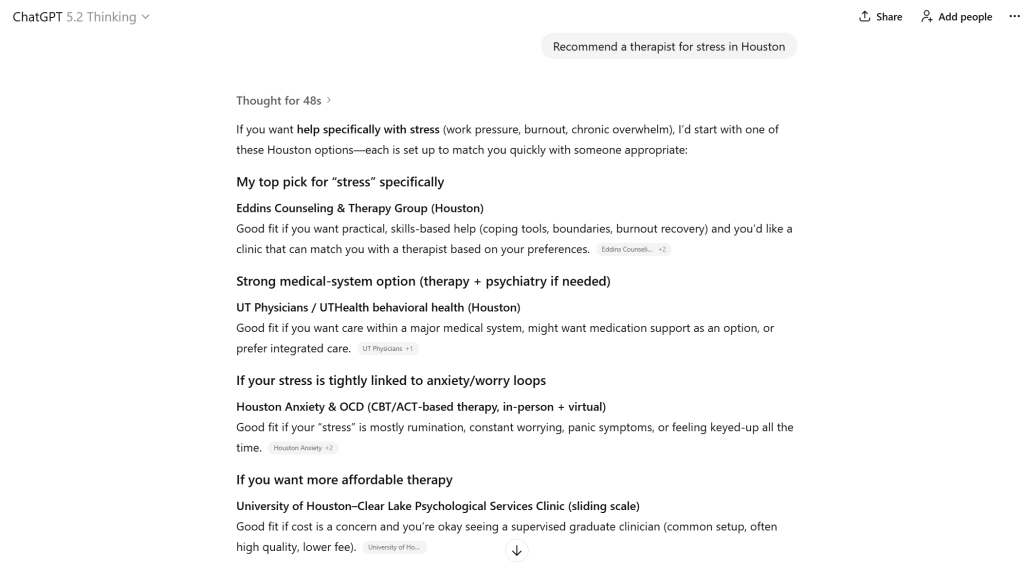
With “Thinking” enabled, the LLM spends nearly a minute performing research on our behalf.
If we look at the source code behind this webpage, we can see more detail about what ChatGPT is actually doing, such as the searches it is performing.
{
  "search_query": [
    {
      "q": "Houston Anxiety & Stress Center CBT therapy Houston",
      "recency": 30
    },
    {
      "q": "The Menninger Clinic Houston outpatient therapy anxiety stress",
      "recency": 30
    },
    {
      "q": "University of Houston Psychological Services Center counseling clinic",
      "recency": 365
    },
    {
      "q": "UTHealth Houston behavioral health clinic therapy anxiety stress",
      "recency": 365
    }
  ],
  "response_length": "short"
}
We can see that the LLM ran these four web searches through its internal search engine, giving it webpages to look through.
Some of the searches are looking for more detail related to each practice’s stress/anxiety-related services. “Recency” refers to how recently results should have been published/updated.
In total, the LLM read 128 different webpages to gather data it used for its recommendations. Once it ingested enough data, it analyzed what it found, and ordered its recommendations based on their perceived relevance to us and our query, before presenting a final response.
As we can see, AI relies heavily on web search and webpages to surface up-to-date information, as well as to train its broader understanding of the world.
As a result, the process of AIO is very similar to SEO. AI still relies on traditional search engines to perform large quantities of research.
However, there are some differences between the two, and more specific things you should check to ensure you’re getting as many referrals from LLMs as possible.
Step #1: Optimize your website
The best thing you can do to improve your AI search performance is to optimize your website for LLM visibility.
This does not normally involve a huge amount of work, and does not mean making your website experience worse for human readers.
Instead, it means clearly and thoroughly describing who you are and what you do.
LLMs read through your website content to build their understanding of your practice. So, just like with your human audience, you should provide sufficient detail to explain what people need to know about your service.
This includes:
- Who you help
- The problems you help with
- The treatment methods you use
- Your (or your team’s) qualifications and experience
- Whether you provide online or in-person therapy, or both
- What insurance you accept
- How people can start working with you
- What your availability looks like – how quickly you can generally fit people in
For the areas you specialize in, it is helpful to be thorough in discussing the first three items on this list in particular.
For example, if we look at the website that appeared as the first recommendation for a stress therapist in Houston on our prior search, we can see that it has a detailed specialty page discussing stress, including its symptoms, different types of stress, and how these problems are addressed.

This website appeared as the first recommendation for this query in large part because it has content highly geared towards helping with stress specifically.
While SEO has much more of a focus on keywords, this isn’t so much the case with AIO. LLMs read through and parse your website in a similar way to how a human researcher would.
However, ranking higher in search engines is helpful in improving your AI visibility, since AI tools still rely so heavily on search engines. So, other SEO improvements you can make on your website will also help from an AIO point of view.
This can include things like:
- Ensuring keywords you want to target are mentioned in the page title, and in the page’s H1 Heading (the main header on the page).
- Ensuring your pages are mobile-friendly, meaning that the font is legible and images are easy to view on small screens. Google for example crawls and assesses webpages based on how they appear on mobile devices.
- Ensuring your page is accessible to people using screen readers and other assistive technology.
For more information on improving your SEO as a therapist, read our more in-depth guide to therapy practice marketing.
Step #2: Get mentioned in more places
Apart from reading your website, LLMs also use other sources to understand your therapy practice, and decide whether to recommend you or not.
The primary purpose of using these external sources is to assess your reputability.
Rather than just taking your website content at face value, LLMs also assess how you are described elsewhere on the web, and where else you are mentioned, to decide whether you are trustworthy enough to recommend to the user.
This means, to improve your AI search visibility, it can be very helpful to get mentioned in more places around the web – especially on other sites that are generally considered trustworthy.
As the AI ingests more data and retrains its internal models, you want it to see your name or business name as much as possible, to reinforce that you are a credible choice.
To improve your visibility, this could involve:
- Listing on the Better Business Bureau
- Listing with your local Chamber of Commerce – many list member businesses by name on their websites
- Listing on therapist directories – make sure to sign up for our one at Counseling.co free of charge
- Being featured in industry publications like Counseling Today
- Being featured on local news websites
- Collaborating with other local businesses in a way that gets you mentioned on their website or social media
There are a million ways to go about building mentions like this.
Some mentions are harder to get than others, but fortunately, you can make a lot of progress by focusing on the ones in your direct control, such as directory listings.
The harder ones – like getting featured on local news – do take time to achieve, but can be incredibly valuable for your AI visibility.
Step #3: Get more reviews/testimonials
The other way LLMs assess your reputability is to read through client reviews.
This is especially true for Google reviews, which Google’s Gemini LLM can read, as well as reviews on other platforms like Yelp.
However, this also relates to testimonials you display on your website, which AI tools often take at face value.
We know you may not be able to or want to solicit reviews, as it goes against many therapists’ codes of conduct. And you may not feel comfortable displaying testimonials on your website for a range of very valid reasons.
The thing is, LLMs are programmed with a sort of artificial empathy. Often, human stories and experiences can be quite a powerful way of differentiating your web presence in the eyes of an LLM.
In our earlier example, one of the first websites that ChatGPT looked at belongs to the Menninger Clinic.
On their homepage, they have a large section dedicated to “Patient stories”.

After looking at this, ChatGPT then went and read through its Yelp reviews:

Eventually, it decided that Menninger was best for people looking for higher-intensity levels of care, and recommended it further down in its response.

So, if you feel comfortable doing so, anything you can do to get more testimonials and reviews, either on your website or elsewhere on the web, will help to improve your AI search visibility.
If you can’t or don’t want to ask for reviews, and decide not to display them on your website, this is completely fine – but make sure to have a Google My Business profile set up, so that people can leave reviews on your Google search result listing if they want to.
Step #4: Ensure consistency in your web presence
A common mistake we see therapists make is forgetting to update their online profiles when they change their specialty, therapy mode, or other aspects of their care or their practice.
The absolute last thing you want is an AI reading conflicting information about you or your services. If it does, the LLM will very likely discard you from its shortlist of recommendations, because it will perceive that it could be providing wrong or confusing information to the user.
LLMs are trained to avoid surfacing incorrect information at all costs, though in practice they still do this frequently.
For instance, if you are listed as specializing in trauma/PTSD in one place, but stress/anxiety in another, the LLM may search more to determine which is correct, but in most cases it will give up and find another recommendation, to avoid wasting the user’s time.
Therefore, you need to ensure that you are described consistently across the web, especially in terms of what you do, who you help, your licensing/qualifications, and what you specialize in.
To check how you’re being described:
- Ask one or two different LLMs for a complete overview of you, and look for any factual inaccuracies. If anything is wrong, check its sources – assuming the AI did not hallucinate what it wrote.
- Do a Google search for your exact name in quotation marks. If you have a relatively common name, include other related terms, not in quotation marks, to narrow down your search a bit. For example: ‘”tom paton” counselor.’ If an LLM has indicated incorrect information about you but won’t tell you where it got this from, you can often find the source by searching for it in Google, using a term like ‘”tom paton” ptsd counselor.’
Step #5: Create content answering specific questions in your niche
As well as searching for therapist recommendations, people are also using AI to research mental health conditions, investigate their symptoms, and learn about how they can get treatment.
This opens up the opportunity to get in front of more people using AI by blogging, helping to provide sources people can use to learn about these issues.
The play here is not to target extremely broad terms, such as “symptoms of depression.” Instead, try to write about extremely niche subjects.
For example, if you provide faith-based counseling, you might like to write about topics such as “overcoming pastoral burnout”.
Compared to search engines, LLMs will often go searching for much more specific sources, giving you more opportunity to reach people by writing about niche subjects.
But won’t the AI just steal my content?
Yes, it will.
However, most AI tools now show their sources, which can lead to visibility and new client discovery if you approach this the right way.
People facing complex issues do not just do one search – they might send tens or even hundreds of different prompts to surface the information they need.
If you consistently appear as an authority on this niche topic in the user’s answers, they will check out your site to learn more.
Converting traffic and awareness to new clients
Getting more traffic from people earlier on in their journey towards getting therapy is a good start.
However, you need to have the right plan in place to begin getting new clients from this traffic as well.
Here’s what you need to do:
- Ensure you are blogging about things that people are researching on their journey towards seeing a therapist for the first time. For example, when you have initial consultations with clients, what do they normally ask about? This could relate to symptoms, treatment methods, how therapy sessions work, and similar sorts of topics.
- Niche down to the greatest extent possible. You need to position yourself as the authoritative source on the specific issue you’re discussing, so that you are often or nearly always cited by ChatGPT for queries related to this topic. If you choose a very broad niche that a lot of people are already blogging about, doing this is next to impossible. For example, maybe you help LGBT couples with sexually-related difficulties, or focus on assisting college students specifically.
- In your articles, and on your website more broadly, have a clear call to action, making it obvious what the next steps are if someone wants to get help. On your blog pages for example, you could end with a personal introduction describing what you do, and including a link to your contact form.
Conclusion
We hope this was helpful!
If you’re looking to get your therapy marketing plan checked over, or have any questions about improving your SEO or AI visibility, book a consulting call with me at a time that works for you.